May 2026 · The Qnèctra Systems Brief™
Operating Rhythm as Operational Design
May Debrief
Welcome back to The Qnèctra Systems Brief — a monthly note on the art and architecture of modern operations.
Monday morning. I opened the same workflow register I open every Monday morning. The file looked the same. The numbers looked the same. The dashboard at the top said everything was green.
Something was off anyway.
It took me a few minutes to find it. A definition had drifted. Not in the policy — in the practice. The team had been resolving exceptions a slightly different way for three weeks, and the register hadn't caught up. The architecture was sound. The operation was running. And the slow drift was already there, two degrees off course.
That's the month in a sentence.
Last month I argued that the economics of intelligent operations live in three layers, and that the accountability gap most operators are facing is a measurement gap. That argument is true. It is also incomplete. Because a measurement architecture, however well-designed, does not produce signal on its own.
Someone has to run it. On a schedule. With enough discipline that what was true at build is still true a quarter later.
That is the maintenance layer. And it is not optional.
Boards are starting to ask about it. Investors are pricing it. CFOs are requiring it on a cadence the operations team did not plan for. The pressure to install operating rhythm is no longer internal — it is becoming structural.
If April was about understanding what your AI is worth, May is about installing the rhythm that keeps it worth something.
This is where May goes.
Signals: The Rhythm Pressure Point
AI is no longer judged by whether you are experimenting. It is judged by whether your operating rhythm can show measurable value every month. Three things surfaced in the last month that are pushing that judgment into the rooms where it is most uncomfortable: the board meeting, the CFO review, the investor narrative.
1. Boards are asking a different question about Agentic AI. Not "what are we deploying?" but "what are we accountable for?" That shift has a concrete implication. A board-accountability question requires a board-readable answer — something a director can verify in fifteen minutes without re-learning the architecture every quarter. Most operating teams do not have that artifact. Which means the question will land before the answer is ready.
2. Institutional capital is moving from AI applications to AI infrastructure — and the expectations travel downstream. KKR is preparing a $10B+ infrastructure vehicle — Helix Digital Infrastructure — led by Adam Selipsky, former CEO of AWS. You are not raising a $10B fund. But your investors sit in the same LP networks as the people who are. When capital at that scale declares AI infrastructure a durable asset class, it resets the benchmark for what "results" means — all the way down to the operating review of a $1M fintech. The expectation does not stay at the top. It migrates into your board deck, your budget scrutiny, and the investor narrative you are building for your next raise.
3. The CFO question is no longer annual. It is monthly. A year ago, AI ROI was a strategic conversation — interesting, exploratory, not yet accountable. That time is over. The question
What did we actually get back this month?
is now on the calendar. Most operations teams cannot answer it cleanly, because the architecture was built to produce intelligence, not to produce a number on a schedule.
Same pressure point, three doors. If your operating rhythm cannot produce visible, measurable results — monthly, for a board, for an investor, for a CFO — you are not behind on AI strategy. You are behind on the answer that everyone in that room is about to ask.
The teams that built rhythm in early will not have to retrofit it under scrutiny. The teams that did not, will.
Framework in Action
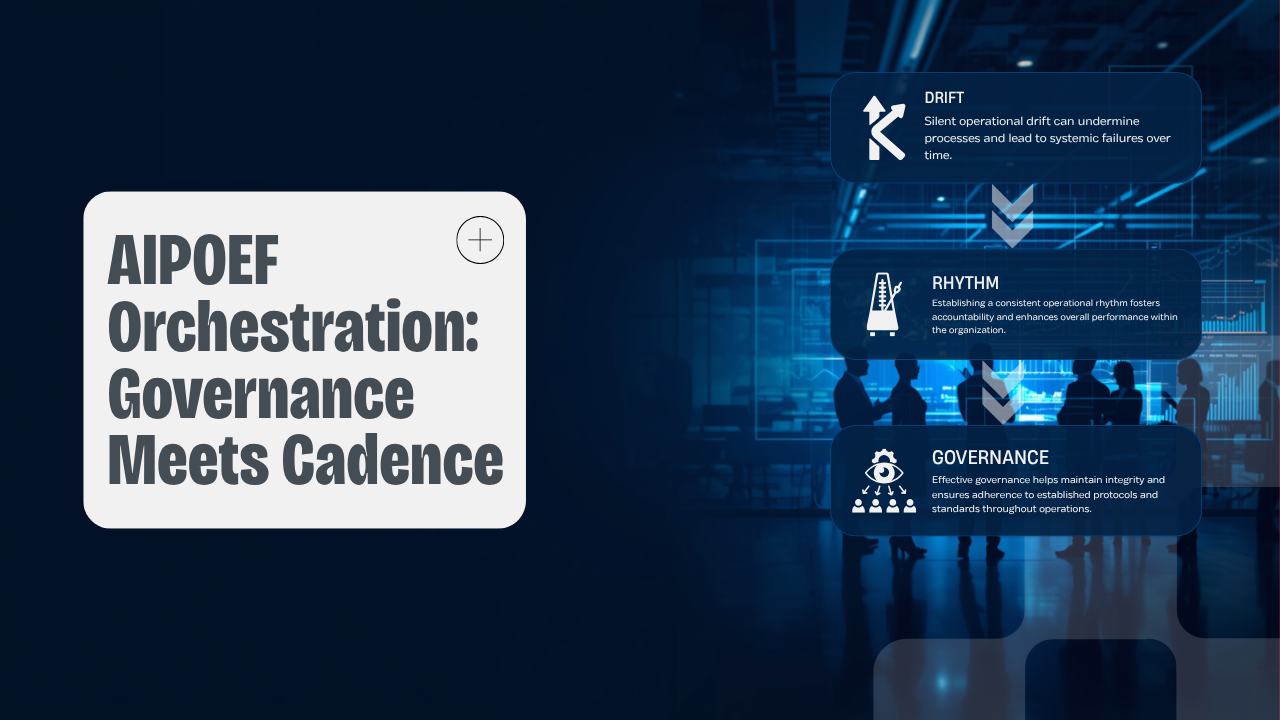
Orchestration is where governance and cadence stop being separate disciplines
The AI-Powered Operational Excellence™ Framework moves through four stages: Automation, Augmentation, Intelligence, and Orchestration. Each one needs its own rhythm of review, measurement, and correction. But the stage where this becomes most visible — and most consequential — is Orchestration.
Orchestration is coordinated humans, agents, and data inside a single governed flow. It is also the stage where no single owner can see the whole flow at once. That is what makes it powerful. It is also what makes it fragile to unattended drift.
Imagine a mid-stage fintech with three agents running inside an underwriting workflow. One handles document intake. One does first-pass risk scoring. One drafts the approval memo for a human reviewer. The architecture is sound. The agents work. The cycle time is half of what it was a year ago.
Six months in, something has quietly changed.
The document-intake agent has been routing edge cases to the risk-scoring agent that should have been escalated to a human. The risk-scoring agent is interpreting one input slightly differently than the policy intends, because exception handling has evolved faster than the written rule. The approval-memo agent is producing memos that sound right but are pointing the human reviewer at the wrong page of the file.
No one set out to break anything. The drift is the work itself.
This is the stage where the guardrail and the rhythm stop being separate problems. A guardrail without a cadence is a relic — it still looks like a guardrail; it no longer does the work of one. A cadence without a guardrail produces meetings without consequences.
The fix is not a better model. It is a weekly orchestration review that pulls a sample of decisions across all three agents, asks whether the workflow is still doing what it was designed to do, and adjusts the guardrails before the drift compounds.
That is what governance and cadence look like when they are running together. They are not two boxes on an org chart. They are the same operating muscle.
Architecture decides what an intelligent operation can become. Cadence decides whether it ever gets there.
Field Intelligence
What "agent-ready" operations actually look like
I have seen two versions of the same agent deployment recently. Same vendor. Same workflow target. Same model class.
One worked. One did not.
The one that worked had three rituals in place before the agent went live:
A weekly fifteen-minute review where the team that owns the workflow looked at every escalation the agent produced. Not to fix the agent — to learn what the agent was encountering, and what the surrounding workflow was asking it to do that it should not.
A monthly governance calibration where the operator who owns the process — not the team that built the agent — checked whether the guardrails were still aligned with current reality. Auto-approve thresholds. Escalation routes. Audit log integrity.
A quarterly scope review where the agent's actual behavior over the last 90 days was checked against its sanctioned scope. Because agents start handling adjacent work when the workflow asks them to, and adjacent work is where compliance debt accumulates.
The deployment that didn't work had none of these. The agent ran. The dashboard was green. The team explaining it to me later used slightly defensive language about what the agent was supposed to do.
The pattern carries past agents. What has to be true for an agent to function as a reliable participant in the business is what has to be true for any intelligent operation to hold.
The actor changes. The rhythm requirement does not.
Diagnostic Corner
The Operating Rhythm Check
The three-layer ROI framework from April established what an intelligent operation should be measuring. The question this month is whether anyone is actually measuring it on a schedule.
Five questions. Five minutes. The value is in the hesitation, not the score.
-
Do you have a weekly operations review for your intelligent workflows — and does it look at exceptions, not just throughput? Throughput tells you the work happened. Exceptions tell you what the work is becoming.
-
Do you have a monthly governance calibration — and does it touch the actual guardrails, not the policy document? A review that re-reads the policy is theater. A review that pulls a sample of decisions and asks whether the guardrail behaved as intended is the real thing.
-
Do you have a quarterly economics audit that runs the three-layer model — full investment cost, short-horizon returns, and at least one compounding indicator? Layer 1 alone is a CFO conversation you cannot win.
-
Is there a named owner for each of those cadences — not a team, a person? Rhythm without an owner is a recurring calendar invite no one prepares for.
-
When the last of these cadences ran, did it produce a decision — or a status update? A cadence that does not produce decisions decays into a meeting. A meeting that does not produce decisions decays into nothing.
If you hesitated on more than one, the gap is not in the AI. The AI is probably working. The maintenance layer underneath it is not.
The AI Opportunity Blueprint is the structured starting point for installing it — mapping where work actually breaks, defining the measurement architecture that makes the three-layer ROI visible, and sequencing the operating rhythms that keep that architecture producing signal instead of decay.
👉 Explore the AI Opportunity Blueprint
The Systems Architect's Journal
Monday morning, looking at my own system
The register file I open every Monday morning is called _register.md. It lives in a folder I built six months ago, and it contains the current state of every workflow Qnèctra runs on. Who owns what. What's due. What changed last week. What hasn't been touched in too long.
I built it because I knew I would forget to run my own system without it. I run it because I have learned, the hard way, that systems designed to endure are not the same as systems that endure.
The design phase is the easier half. Anyone who has scaled an operation knows roughly what a good system looks like. The shape is legible. The principles are not novel.
Where the difficulty lives is in the discipline of returning. Opening the same file on the same morning of the week. Asking the same uncomfortable question of the same workflow. Watching for the drift that has not become visible yet, because no one has looked for it on schedule.
This is what "designing for absence, not heroics" actually requires once the design is done. It is not the architecture. It is the rhythm that keeps the architecture from quietly becoming a relic of a moment in time.
The drumbeat I keep returning to is systems that endure. Building one is teaching me that the verb in that phrase is doing the work. Endure is not a property a system has on the day it is built. It is a property a system earns over time, by being maintained well enough, often enough, that drift does not get ahead of attention.
The maintenance layer is the system, once enough time has passed.
I learned that lesson first as an operator running global support at a fintech that scaled from $5M to $100M. The systems we built early were not the systems we shipped at scale. The systems we shipped at scale were the early systems, plus six years of maintenance. The maintenance was the work. The architecture was the starting condition.
That distinction is what I am bringing into every conversation about intelligent operations now. The architecture is necessary. The rhythm is what makes the architecture worth having.
The Build Ahead
Once the rhythm is in place, the actor question follows
The argument has built in a deliberate sequence. February named the shift: the token is the unit of work. March established that agents inherit the operating environment they enter. April mapped the economics of intelligent operations into three layers and named the accountability gap that follows. May has put the maintenance layer underneath all of it — the rhythm that keeps the architecture honest and the economics visible.
Once that rhythm is in place, a new question becomes answerable that was premature to ask before.
Not can we deploy an AI agent? Most operators can. The platforms are available. The models are sufficient.
The harder question — and the one June is going to sit with — is what has to be true operationally before an AI agent can function as a business actor. A reliable participant in the work. Not a fast executor of tasks no one is supervising.
That answer is not a model choice. It is an operating-environment specification. Clean data the agent can trust. Decision layers a human can audit. Governance hooks that catch drift before it compounds. Escalation routes that land with the right person at the right time. And underneath all of it, the rhythm this edition has been about.
The industry is starting to use the frame agents as business actors, not just business tools. Qnèctra's answer to it is straightforward: the actor question is an operating-rhythm question first.
The architecture supports the actor. The rhythm sustains the architecture. The actor extends what the operation can do.
That's where June goes.