
June 2026 · The Qnèctra Systems Brief™
When a Tool Becomes an Actor
June Debrief
Welcome back to The Qnèctra Systems Brief — a monthly note on the art and architecture of modern operations.
One of the agents I run has been working cleanly for weeks. It moves a workflow that used to sit on my desk. The output is good. The dashboard at the top of it is green every single morning.
Last Tuesday I caught myself reviewing its work line by line anyway. The way you check a new hire's first month before anything leaves the building.
The agent did not need the review. I needed it.
That gap is the whole subject of this edition. The agent could run. The question I was actually sitting with was quieter: was the operation around it ready to treat it as a participant in the work, or was I still supervising a tool I did not fully trust?
The distance between those two is not closed by a better model. Last month I argued that operating rhythm is the maintenance layer that keeps intelligent systems honest; this month picks up the thread May left open. Once the rhythm is running, a new question becomes answerable that was premature before: what has to be true operationally before an AI agent can act as a business actor — a reliable participant the operation is built to trust, not a fast executor of tasks no one is supervising.
The answer is not a capability. It is an environment. And AI doesn't fix chaos; it amplifies it — which means deploying an agent into an unready operation does not produce an actor. It produces a faster version of whatever was already broken.
This is where June goes.
Signals: The Actor Threshold
The frame is arriving everywhere at once: agents are no longer sold as tools you operate, but as actors you delegate to. Three things surfaced last month pushing that frame into the rooms where it matters.
1. The "build your own Chief of Staff with AI" pitch is everywhere — and it answers the wrong question. The headline version promises a Chief of Staff agent that saves $160k and ten hours a week. The math is seductive and the framing is a trap: it treats the agent as a headcount line to delete, not as a participant that has to be governed. Cost reduction is the visible number; the substrate question — can the operation trust this thing to act — is the one the pitch never reaches.
2. Tech leaders are redesigning their foundations, not their tooling. IBM's Institute for Business Value published its 2026 Tech Leader Study this month, and it names the missing variable directly: organizations scaling AI are rebuilding their operational foundations, not buying more tools. That is third-party validation of an argument Qnèctra has been making since March. The foundation is the work; the agent is what the foundation makes possible.
3. Anthropic filed for its IPO. Qnèctra's primary AI infrastructure vendor is moving toward public markets, with an autumn listing expected. Pricing and access terms will shift, but the more durable signal is what the filing represents: AI infrastructure is moving from aspiration to accountability. When the capital layer gets priced in public, the expectation of measurable, auditable results travels all the way down to the operating review of a single fintech.
Same threshold, three doors. The market has decided agents will act. It has not yet decided what an operation owes an agent before it lets one.
Framework in Action
The five conditions an agent inherits before it can act
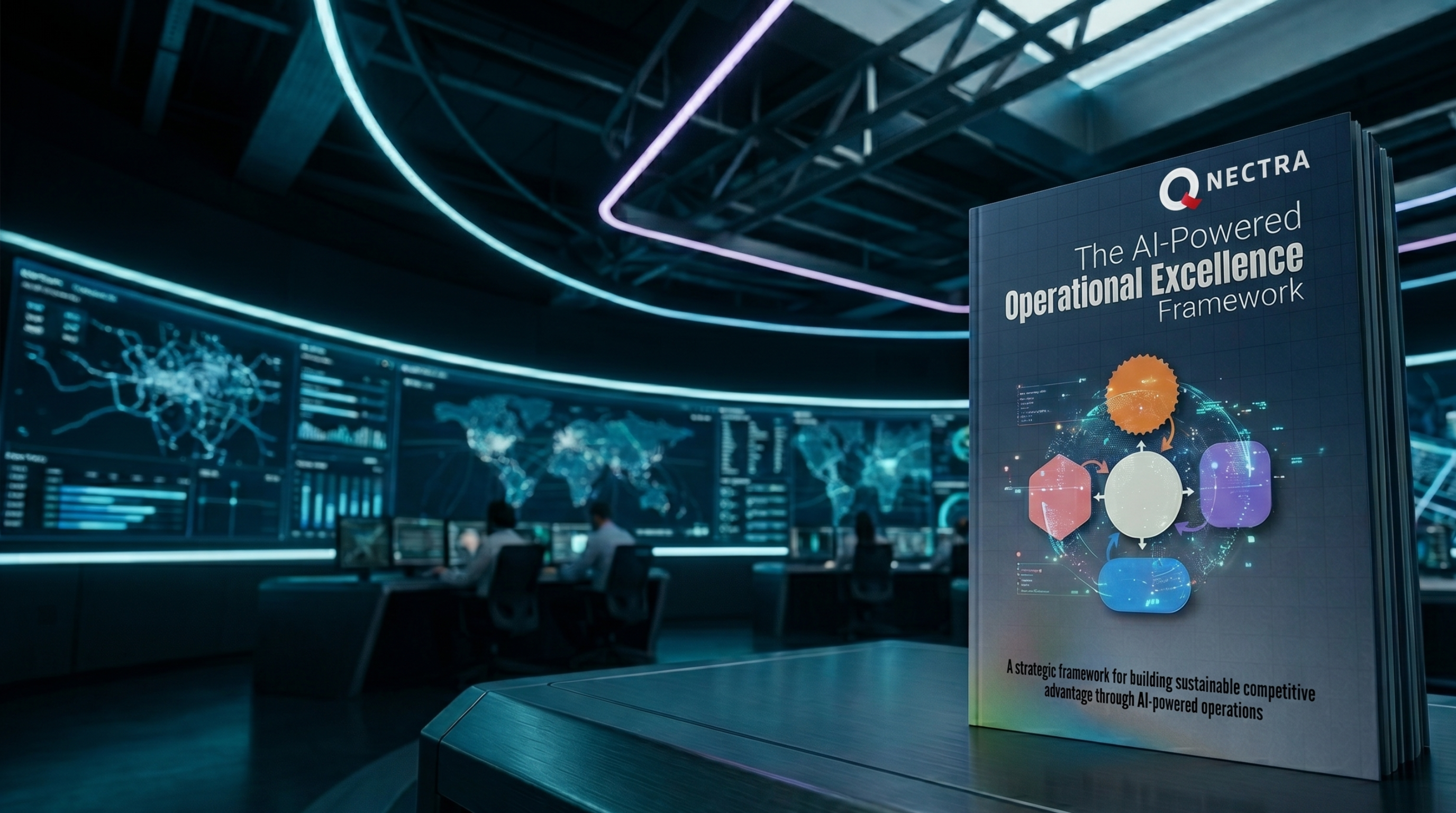
May's Build Ahead made a promise: that the answer to the actor question is an operating-environment specification with five elements. Here is the architecture, mapped against the AI-Powered Operational Excellence™ Framework (AIPOEF™) and its maturity arc — Automation, Augmentation, Intelligence, Orchestration. Each element has to be in place at a specific point in that arc before an agent earns the right to act rather than merely run.
Clean data the agent can trust. The Automation-stage foundation. An agent reasoning over data it cannot rely on does not produce judgment; it produces confident error at machine speed. This is not a data-quality project bolted on later — it is the precondition for everything above it.
Auditable decision layers. As the agent moves into Augmentation, its decisions have to be legible to a human after the fact — not just the output, but the path. A decision you cannot reconstruct is a decision you cannot defend, to a regulator or to yourself.
Governance hooks that catch drift. At the Intelligence stage, the agent starts handling adjacent work the workflow quietly hands it. Governance hooks are the instrumented checkpoints that notice when behavior has moved off its sanctioned scope, before the drift compounds into something you discover in an audit.
Escalation routes that reach the right person. Also an Intelligence-stage requirement. An agent that hits the edge of its competence with nowhere to send the exception is an agent making decisions it should be handing up. The route has to land with a named owner, in a form they can act on.
Operating rhythm. The Orchestration-stage layer that keeps the other four honest over time — the recurring review that confirms the data is still clean, the decisions still auditable, the hooks still firing, the routes still landing. This is the maintenance layer May was about. Without it, the specification holds at build and decays in practice.
An agent earns the designation "business actor" when the operation around it is designed to trust it — not when the model is capable enough, not when the dashboard is green, but when the operating environment is clean, auditable, governed, and maintained.
Baseline first. Governance before automation. The actor is the last thing the operation earns, not the first thing it installs.
Field Intelligence
Where the specification breaks in a lending workflow
Take the architecture into a fintech lending or underwriting operation and watch where it strains. The clean-data assumption breaks first, and quietly. Underwriting data arrives from a dozen upstream sources, each with its own definition of the same field, and the agent trusts all of them equally. Under low volume, a human notices the mismatch. Under volume, no one does — and the agent has been reasoning over a definition that drifted two degrees off three weeks ago.
The decision-layer audit collapses next, under exactly the pressure it was built for. When volume spikes, the instinct is to loosen the logging that makes decisions reconstructable, because logging is the cost you can cut without anyone noticing today. The auditability you sacrifice in the busy quarter is the auditability you needed in the busy quarter.
And the most fragile single point sits underneath both: the compliance data layer. The regulatory ground is moving in two directions at once. State-level enforcement in the MCA space is tightening, with disclosure obligations expanding across a growing list of states, while federal data-collection requirements are softening with the CFPB's 1071 posture in retreat. An operation caught between a tightening floor and a softening ceiling cannot lean on the regulator to tell it what to capture. It has to specify its own compliance data layer — and in most otherwise well-designed deployments, that layer is the weakest part of the build.
May told the story of two agent deployments — same vendor, same workflow, same model class, one that worked and one that did not. Here is the structural reason the one that worked, worked: it had specified all five elements before the agent went live. The clean data was real. The decisions were reconstructable. The hooks fired. The routes landed. The rhythm ran. The one that failed had a green dashboard and nothing underneath it. A green dashboard tells you the agent ran. It does not tell you the agent should have.
Diagnostic Corner
The Actor-Readiness Check
Take your highest-stakes AI deployment — the one closest to a real decision, real money, or a real regulator. Ask one question per element. The value is not in the score. It is in where you cannot answer cleanly, because that is exactly where the gap is.
-
Clean data — can the agent trust its inputs? If the same field arrives from three sources with three definitions, the agent is reasoning over a contradiction. Do you know which definition it is using right now?
-
Auditable decisions — can you reconstruct why, not just what? Pull one decision the agent made last week. Can you trace the path it took, or only the answer it produced?
-
Governance hooks — would you catch drift before an audit does? If the agent started handling adjacent work tomorrow, what instrumented checkpoint notices, and how long before someone sees it?
-
Escalation routes — does the exception reach a named person? When the agent hits the edge of its competence, does the hand-off land with an owner who can act, or does it land nowhere?
-
Operating rhythm — does someone confirm the other four still hold, on a schedule? A specification verified once at build and never again is a specification you are trusting on faith.
If you hesitated on more than one, the gap is not in the model. The model is probably fine. The operating environment underneath it is not yet built to let it act.
That evaluation is exactly what the AI OS Workshop runs live — against your actual workflows, your actual data layer, and your actual governance gaps, not a generic checklist.
The Systems Architect's Journal
The morning I stopped reviewing every cycle
I remember the specific morning I stopped reviewing one of my agents line by line. Not because I decided to trust it in the abstract, but because the operation around it had finally earned the right to be trusted, and reviewing every cycle had become the thing slowing the work down rather than protecting it.
For weeks before that, my review was the governance layer. I was the escalation route, the audit trail, and the drift detector, all running in my own head on no schedule but my attention. That works at one agent. It does not survive two — it is a system that depends entirely on me being present and suspicious, the opposite of designing for absence, not heroics.
What changed was not the agent. It was everything I built around it. I gave it data I had actually reconciled instead of data I hoped was right. I made its decisions reconstructable, so I could check a sample instead of every case. I instrumented the checkpoints that would tell me if it wandered, and wired the exceptions to land somewhere specific. And I put the whole thing on a rhythm, so the trust I extended on Tuesday was re-earned the following Tuesday rather than assumed forever.
Only then did supervising turn into trusting. Supervising means the operation runs on your vigilance. Trusting means it runs on its architecture, and your vigilance is reserved for the sample that tells you the architecture is still holding.
That is the whole transition agents-as-business-actors describes. Not a model crossing a capability line. An operator finally building the environment that makes delegation safe — and then, for the first time, actually delegating.
The Build Ahead
Once the environment is built, the question becomes what it is worth
The argument has moved in sequence. March established that agents inherit their operating environment. April mapped its economics into three layers. May installed the rhythm that keeps it honest. June has specified what the environment must contain before an agent can act inside it. There is a destination this points toward, and it changes the conversation from cost to value.
An operation that has built the five-element specification has done more than make an agent safe to delegate to. It has started converting intelligence that used to live in people's heads — repeating as salary, capping at what any one person can carry, walking out the door when they leave — into something the operation owns and that compounds with every run. That is a different economic object than a headcount line you deleted. It is closer to an asset than an expense.
That is the territory July is going to sit with: what an operation built on owned intelligence is actually worth, and why that reframes the case for AI transformation for operators who already understand balance sheets and compounding. The specifics of that framing are still being set — I am not pre-committing the full July angle here, only naming the direction the actor question opens onto.
The environment makes the actor possible. The actor changes what the operation can do. What the operation becomes worth is the question waiting on the other side.
That's where July goes.
Until the next edition of The Qnèctra Systems Brief™.